Skip to content
Start an assessment
The Aroc Growth System

Five stages between existing and being chosen.

Every business online passes through the same five stages, in the same order. Most growth problems are not a failure of effort — they are effort applied to the wrong stage.

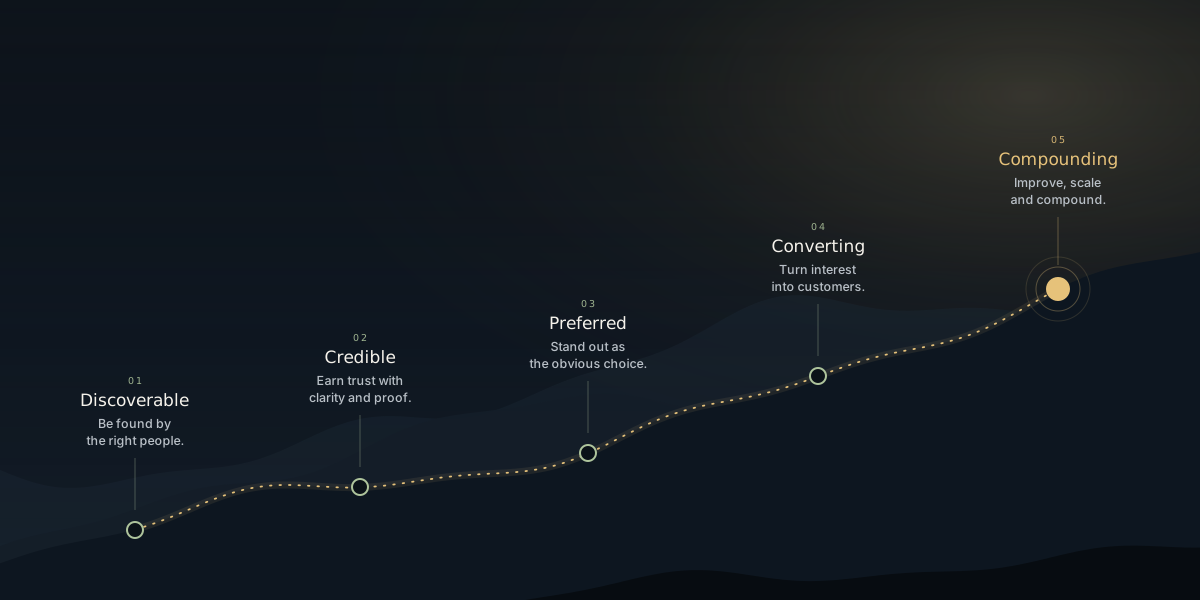
The Aroc Growth System — five stages plotted as waypoints along an ascending ridgeline: Discoverable, Credible, Preferred, Converting, Compounding.
Why a system at all

Because “improve your online presence” is not a plan, and everyone selling one means something different by it.

A designer means the site should look better. An SEO means it should rank. An agency means you should advertise. Each is describing the stage they happen to work on, and none of them can tell you whether it is the stage that is costing you money.

The Growth System exists so that a business, its supplier and its evidence can all describe the same problem in the same words — and so a finding made in month one is still legible in month twelve.

01

Discoverable

Can the right people find you?

Not whether you have a website. Whether you appear at the moment someone is looking for what you sell, in the place they are looking — the map, the search results, the directory, the platform.

Discoverable is where most money gets spent and where the least attention gets paid to whether the traffic is the right traffic at all. Being found by the wrong people is not a smaller version of success. It is a different outcome entirely.

02

Credible

Do they trust what they find?

Someone has found you. Their next act is to check you — and this is the stage almost nobody designs for, because it happens somewhere the business cannot see.

Credibility is not a design quality. It is consistency: the same name everywhere, an address that matches the map, a phone number that appears, reviews that are visible, and nothing that looks abandoned. Finding nothing is worse than finding something small.

03

Preferred

Do they have a reason to choose you?

Found and trusted still leaves you as one of several. Preference is the stage where a customer decides you specifically, and it is decided by whatever is visible in that moment — what you actually offer, what it costs, and what makes you the better answer.

This is the stage businesses most often assume they have already won, because they know why they are better. The question is whether a stranger can tell in ten seconds.

04

Converting

Can they act without friction?

Someone has decided. Now they have to do something — call, message, book, walk in. Every extra step, missing detail or unanswered question is a place they stop.

Conversion failures are rarely dramatic. They are a phone number that is not on the listing, a contact form that quietly stopped delivering, an address with no floor number, or opening hours that are wrong on the one surface the customer checked.

05

Compounding

Does it get better over time?

The first four stages can all be working and the business can still stand still — because nothing accumulates. Compounding is the stage where each month starts from what the last one proved, rather than from instinct.

It requires two unglamorous things: measurement that actually runs, and someone who looks at it and decides. Without them a business can feel busy for a year and be in exactly the same place.

The principle that makes it useful

Only the earliest broken stage matters.

The stages run in order, and each depends on the one before it. Work done on a later stage while an earlier one is broken is not wasted exactly — it simply cannot pay, because the customers it is meant to serve never arrive.

  1. 01

    Discoverable

    working
  2. 02

    Credible

    the constraint
  3. 03

    Preferred

    cannot pay yet
  4. 04

    Converting

    cannot pay yet
  5. 05

    Compounding

    cannot pay yet

This is why so much digital spending produces so little. A business whose constraint is credibility can buy advertising for a year and see almost nothing, because every extra visitor arrives at the same moment of doubt. The advertising was not bad work. It was work at stage one for a problem at stage two.

It also means the answer is often cheaper than expected. The earliest broken stage is frequently a listing, a missing price or a broken link — not a rebuild. We would rather tell you that than sell you the larger thing.

How the system is used

The same five stages, at every point in the relationship.

This is what makes it a system rather than a diagram. A finding recorded in an assessment is still traceable in a report eleven months later, because nothing has been renamed in between.

Diagnose

Assess

Every stage examined with evidence, and the earliest broken one named as your constraint — with what it is costing you.

Implement

Build

The constraint fixed, and only the constraint. The baseline is recorded first so the effect can be shown afterwards.

Compound

Grow

Every month, the stages are reviewed again. When the constraint moves, the work moves with it.

And it is the structure of the monthly report — so you are never reading a different vocabulary from the one you bought.

Which stage is yours?

An assessment answers it with evidence rather than instinct — the earliest stage that is breaking, what it costs, and what to do about it first.

Start with Assess  ·  $950